Tuesday, 21 August 2012

"Nothing is missing and nothing is superfluous"


Federico Mompou (1893-1987)

In the 1920s, the Spanish composer Mompou was part of a group of artists, writers, and musicians called Noucentistes ("Twentieth-centurists") whose aesthetic aim was a return to clarity and simplicity. Inspired more by the French impressionists than by the modernism of Stravinsky or Hindemith, Mompou declared, "My only desire is to write works in which nothing is missing and nothing is superfluous."

Much of Mompou's set of Cançons i Danses for piano draws on Catalan folk themes, but this one, No. 6 -- my favorite  -- is entirely original. You can go to YouTube and hear the song section played by the legendary pianist Arturo Benedetti Michelangeli, but the dance is omitted. You can hear the complete No. 6, song and dance, played by the composer himself, but Mompou's aging fingers were regrettably past the dancing stage when he recorded it. (It's no disrespect to Mompou to say that someday I'd love to hear this music in the hands of a great jazz pianist/improviser -- a Rossano Sportiello, for example.)

As usual when it comes to Spanish piano music, Alicia de Larrocha's recording is definitive, the song section memorably lyrical, the dance rhythms beautifully articulated.

Enjoy.


Tuesday, 7 August 2012

Serenade to a bed quilt


It's the biggest, most beautiful present I've ever received: a king-size bed quilt, lovingly made by Brooklyn Baby over many months. BB has become a quilt-making whiz (just one of her many whizbang qualties) but this project eclipses all others in complexity, detailed craftsmanship, and sheer humongosity, which may explain why it arrived six months after my birthday. If ever a gift was worth waiting for, this was it. (The making of this epic production is chronicled here.)

The quilt is called "Bear Pa" (bear paw) and as you can see, it's a model of harmony and balance, its patterns and colors a source of unceasing interest and delight. Now examine the photo above using a high-powered microscope. You'll find exquisite hand stitching around each paw and "free-motion" quilting in the shape of little leaves in the outer borders, making the quilt as pleasing texturally as it is visually. Incredible.

Mom would take one look at this quilt, shake her head in awe, and say, "Imagine, all that work!"

As the adage says, the proof of the quilt is in the sleeping. I've lived with "Bear Pa" for well over two weeks now, and can report having copped many soothing z's beneath it. Nor did the quilt's tactile appeal go unnoticed by our two pussycats, who are expert in the matter of finding good napping places. Upon the quilt's arrival, they promptly pencilled "Bear Pa" into the late-afternoon slot on their daily itinerary. I've been told that, given the choice between hand-made and mass-produced, pussycats will choose hand-made every time. I believe it. When it comes to comfort and pleasure, cats have unerringly good judgment.


How to celebrate and give thanks for such a gift? I consulted my memory-bank (otherwise known as iTunes) for an appropriate song title. Rejecting such obvious, mundane choices as Thanks a Million and other thank-you songs, I settled on Under a Blanket of Blue. Okay, so it's a quilt, not a blanket, and it's not blue, but the title comes close enough, and the mood of the melody is right on the money.

Naturally I thought first of the 1944 Keynote version with Coleman Hawkins, Buck Clayton, Teddy Wilson, Slam Stewart, and Denzil Best. It's a great record, but Hawkins' intense, probing improvisations produce a feeling of agitation not appropriate here.

Taken at a more placid tempo than the Hawkins, this less well-known 1947 version of Under a Blanket of Blue perfectly captures the mood of repose induced by my new quilt. It's a Red Norvo group including Red on xylophone, Benny Carter, alto, Dave Barbour, guitar, Arnold Ross, piano, Billy Hadnott, bass, and Jesse Price, drums, but the highlight for me is the opening chorus, which does not stray far from Jerry Livingston's lovely melody. The theme is stated simply and eloquently by Eddie Miller's tenor sax in a manner aptly described by one perceptive critic as "melting," with Bobby Sherwood taking the B section on cornet, carressing each phrase with Bobby Hackett-like delicacy.

As the "pa" in the quilt's name (and the "bear," too, for that matter) I can't thank BB enough for this precious gift. Imagine, all that work!

Saturday, 21 July 2012

Visiting Mom


Tomorrow we're off to visit Mom to help celebrate her one-hundred-and-first-and-a-half birthday. Still fresh are the memories of her one-hundredth birthday party. The "surprise at 3:00" mentioned on the invitation was a concert by Rebecca Kilgore, Dan Barrett (with trombone), and Dave Frishberg.


That day's musical highlights are indelible in our memory. Becky sang Mom's request Laughing At Life (wise words to live by). Dan played a slyly humorous, slow-tempo Margie (which happens to be Mom's name), a performance that would have delighted Vic Dickenson as much as it delighted us. Mom has always been a big Frishberg fan, and Dave played and sang her favorite Frishberg song, I Want to Be a Sideman. (A one-hundred-year-old requesting I Want to Be a Sideman? How hip is that?)


To honor Mom this year, I turn to another version of Margie, this one recorded in 1938, featuring the great Bill Coleman at his nimble best on trumpet, Alix Combelle, tenor sax, Eddie Brunner, clarinet, and Herman Chittison, piano. If you're wondering why this side swings so fiercely, consider the soloists and the rhythm section: Tommy Benford, drums, and Oscar Alemán, guitar.


Happy one-oh-one-and-a-half, Mom!


Thursday, 12 July 2012

Batgirl defies science!


According to the findings of physicists at the University of Leicester, published in the university's Journal of Special Physics Topics and reported in Wired Science:


Clearly gliding using a batcape is not a safe way to travel, unless a method to rapidly slow down is used, such as a parachute.”
The proposed parachute would surely diminish the impact of Batman’s stylish flourish when he flicks the cape aside on landing — not to mention, detract from the terror it instills in enemies when he goes for the full wing span, narrow-eyed bat impersonation, pre-attack.
Nevertheless, the physics is undeniable.
After accounting for the drag and lift forces acting on Bruce Wayne in flight, the doomed trajectory was calculated. The 15.4-foot wingspan is just half that of an ordinary hang glider and, when launching off an 492-foot-high Gotham city skyscraper and gliding (successfully, the team predicted) for around 1,150 feet, Batman’s velocity would peak at 68 mph before levelling off at a life-threatening 50 mph descent.
The paper does admit that variations in the angle of the glide were not taken into account, and could contribute to a safe landing. However, Batman would need to slow significantly to avoid becoming a messy afterthought for Gotham city’s road sweepers.
The paper also does not take into account Batgirl's fearlessness and dedication to justice. You can see it in her eyes.


Wednesday, 27 June 2012

Lucky Day


This one's dedicated to Brooklyn Girl, Brooklyn Baby (who loved this record when she was little), Miriam, Tina, Legrand Sidney Doggett, and the acai berry. The Revelers' skillful close-harmony singing and the arrangement may be as dated as a 1926 Victrola, but the sentiment expressed is as genuine today as ever.

Friday, 22 June 2012

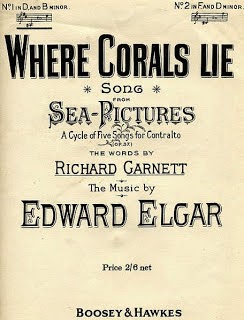
Where Corals Lie

When the glorious mezzo-soprano Janet Baker and conductor John Barbirolli recorded Elgar's Sea Pictures in 1965, it was one of those rare moments when the right music found its ideal interpreters at the peak of their powers. With the stars thus in proper alignment, magic happened.

First performed in 1899, Sea Pictures is a cycle of five songs, with texts by five different poets. I don't love the five equally. In Haven, with words by Caroline Alice Elgar, the composer's wife, is a beauty. Where Corals Lie is my favorite. I hope your computer speakers are good enough to pick up Elgar's orchestral touches as brought out by Barbirolli, especially the woodwind accents and the luminous way the cellos double the vocal line in the second stanza.

The poem Where Corals Lie was written by Richard Garnett. Here's the text, with Elgar's repeats:

The deeps have music soft and low
When winds awake the airy spry,
It lures me, lures me on to go
And see the land where corals lie.
The land where corals lie.

By mount and mead, by lawn and rill,
When night is deep, and moon is high,
That music seeks and finds me still,
And tells me where the corals lie.

Yes, press my eyelids close, 'tis well,
But far the rapid fancies fly
To rolling worlds of wave and shell,
And all the land where corals lie.

Thy lips are like a sunset glow,
Thy smile is like a morning sky,
Yet leave me, leave me, let me go
And see the land where corals lie.
The land, the land where corals lie.

Tuesday, 29 May 2012

Eine kleine cementmusik

They've been working on our street and sidewalks for weeks now, tearing up the old ones and laying down new ones. The noise has been constant, but it's okay -- that's what backyards and headphones are for. The job is nearing its end; a big truck like the one shown above has just pulled up in front of our house. The workmen have been toiling like mad in unseasonable midsummer-type heat and humidity, and I feel for them; hence this small musical tribute by Slim Gaillard, abetted by bassist Bam Brown. This record was a minor hit in the 1940s. As kids we tried to sing it and sound like Slim and Bam, but we couldn't duplicate their unique brand of verbal nihilism.