I grew up on radio and 78 rpm records, so posting audio clips and sharing my favorite music with the world is more than a delight -- it's a miracle. Through trial and (lots of) error I learned how to upload and publish individual audio clips via Hipcast, but publishing two clips in one post had me baffled. I emailed Denise at Hipcast customer support, pleading for help, and she quickly unbaffled me. I created a playlist with Thanks a Million by Louis Armstrong (1935) and How Can I Thank You? with Mildred Bailey and Red Norvo (1938) and clicked on "Publish." Let's see if it works.
Monday, 12 September 2011

Wednesday, 7 September 2011
The hyphen has its uses
I recently read that fashion designer Karl Lagerfeld was "heir to his father's evaporated milk fortune." Does this mean that Lagerfeld's father left him a fortune earned in the evaporated-milk business, or that Lagerfeld's father made a fortune in the milk business and then squandered it?
Recycling, '50s-style
In my Ink Spots post, I mentioned parenthetically that when the Platters' record of My Prayer zoomed to the top of the charts in 1956, we teenagers thought it was a new song. Like so many pop hits of the '50s -- Side By Side (1927), Play a Simple Melody (1914), I Can Dream, Can't I? (1938), Beyond the Blue Horizon (1930), The World is Waiting for the Sunrise (1918), Walking My Baby Back Home (1930), Life is Just a Bowl of Cherries (1931), I've Got the World on a String (1932), Love Letters in the Sand (1931), My Blue Heaven (1924) -- it wasn't new at all.
I can't find the date of composition of Fats Domino's 1956 hit What's the Reason I'm Not Pleasin' You? but I know that Red McKenzie and Bunny Berigan and the Mound City Blue Blowers recorded it in 1935:
Other 1950s recyclings come to mind: Jo Stafford's Make Love to Me was, of course, derived from the New Orleans Rhythm Kings' 1923 Tin Roof Blues, and Elvis Presley's Love Me Tender was nothing but Aura Lee from 1861.
I can't find the date of composition of Fats Domino's 1956 hit What's the Reason I'm Not Pleasin' You? but I know that Red McKenzie and Bunny Berigan and the Mound City Blue Blowers recorded it in 1935:
Other 1950s recyclings come to mind: Jo Stafford's Make Love to Me was, of course, derived from the New Orleans Rhythm Kings' 1923 Tin Roof Blues, and Elvis Presley's Love Me Tender was nothing but Aura Lee from 1861.
We even thought Joe Turner was a new singer. When I saw him at one of Alan Freed's first rock 'n' roll shows at the Brooklyn Paramount, I knew nothing about him and Kansas City and the Sunset Club and pianist Pete Johnson. We had no idea Big Joe had already been shakin', rattlin' and rollin' for over twenty years.
But back to My Prayer. The Ink Spots had scored a hit with the song in 1939, but the melody wasn't new even then. My Prayer was derived from Avant de Mourir, a 1926 composition by Romanian violinist Georges Boulanger (1893-1958), student of Leopold Auer and composer of salon pieces featuring tango rhythms and gypsy-flavored melodies. In 1939, the English lyrics -- uninspired, in my opinion -- were added by Jimmy Kennedy, an Irish songwriter. (Kennedy did a much better job with composer John Walter Bratton's 1907 The Teddy Bears' Picnic, retrofitting it with lyrics in 1932. He was also the lyricist of Red Sails in the Sunset and The Isle of Capri.)
This tango version of Avant de Mourir is from 1929:
Boulanger's own version, played with schmaltz aplenty, can be heard here:
Boulanger plays it at such a funereal pace that the tango rhythm is lost, but considering the title of the piece (and that this is the composer playing it) his tempo seems heartbreakingly appropriate.
Monday, 29 August 2011
A little Red McKenzie for BB
Brooklyn Baby was (I'm guessing) about seven years old. I had just purchased an LP and was giving it plenty of turntable time, so the music formed part of the soundtrack of BB's growing-up years. I hope this post will bring her a pleasant little nostalgia rush on her birthday.
The LP consisted of McKenzie-Berigan sessions from 1935-36, said McKenzie being Red McKenzie, ex-jockey, ex-bellhop, crooner, and hot comb player supreme. On the selection playable below, Red is sans comb-and-paper but avec his Mound City Blue Blowers, who on this occasion were Bunny Berigan, trumpet; Eddie Miller, clarinet; Al Philburn, trombone; Gil Bowers, piano; Nappy Lamare, guitar; Harry Goodman, bass; Ray Bauduc, drums.
Brooklyn Baby is sure to remember Red's rendition of She's a Latin from Manhattan, music by Harry Warren, lyrics by Al Dubin, an exposé of that faux-Cuban terpsichorean Susie Donahue:
She can take a tambourine and whack it,
But with her it's just a racket,
She's a hoofer from Tenth Avenoo!
Not that Brooklyn Baby has anything in common with Señorita Donahue. BB doesn't pretend to be anything but what she is. And what she is, is this: the best daughter one could wish for. Not to mention a wife, mother, and quilter extraordinaire, and a person of substantial accomplishment in her field. Brooklyn Girl and I couldn't be prouder.
Happy birthday, Brooklyn Baby. Take it Red.
The LP consisted of McKenzie-Berigan sessions from 1935-36, said McKenzie being Red McKenzie, ex-jockey, ex-bellhop, crooner, and hot comb player supreme. On the selection playable below, Red is sans comb-and-paper but avec his Mound City Blue Blowers, who on this occasion were Bunny Berigan, trumpet; Eddie Miller, clarinet; Al Philburn, trombone; Gil Bowers, piano; Nappy Lamare, guitar; Harry Goodman, bass; Ray Bauduc, drums.
 |
| Maestro McKenzie and Bunny Berigan, with Forrest Crawford, Morty Stuhlmaker, Eddie Condon, and a young, young Joe Bushkin at the piano. |
Brooklyn Baby is sure to remember Red's rendition of She's a Latin from Manhattan, music by Harry Warren, lyrics by Al Dubin, an exposé of that faux-Cuban terpsichorean Susie Donahue:
She can take a tambourine and whack it,
But with her it's just a racket,
She's a hoofer from Tenth Avenoo!
Not that Brooklyn Baby has anything in common with Señorita Donahue. BB doesn't pretend to be anything but what she is. And what she is, is this: the best daughter one could wish for. Not to mention a wife, mother, and quilter extraordinaire, and a person of substantial accomplishment in her field. Brooklyn Girl and I couldn't be prouder.
Happy birthday, Brooklyn Baby. Take it Red.
Saturday, 20 August 2011
The Spirits of Rhythm

That might be a ukulele, but to me it sounds more like a tipple -- which I think had twelve strings and was often part of the Spirits of Rhythm recordings. The Spirits are contemporaneous with the Mills Brothers (the Mills clan exploded as stars in 1931; the Spirits first recorded in 1933 and never made it in the same way).
All the more reason, then, to revisit the Spirits of Rhythm now. The selection playable below is, by happy coincidence, called Rhythm. It's from 1933 and includes the inimitable scat-singer Leo Watson, Wilbur Daniels, and Douglas Daniels playing tipples, Virgil Scoggins on homemade percussion, and the estimable Teddy Bunn, about whom a much-loved jazz scholar and commentator once wrote, "The world would be a better place if more people knew about guitarist/singer Teddy Bunn."
This one's for you, Mr. Shoes. Feel free to play air tipple while you listen.
And an encore: the Spirits of Rhythm with Red McKenzie.
Wednesday, 17 August 2011
Bunthorne lives!
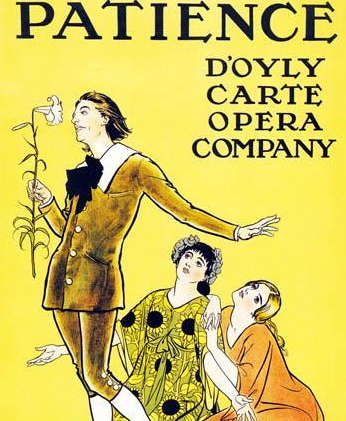
Gilbert and Sullivan's 1881 comic opera Patience may not be their greatest work (for me, Iolanthe and The Mikado show the collaborators in peak form) but it may be the funniest to a modern audience. In my experience, Patience, when well acted and sung, gets the most laughs -- not the ritual, obligatory chuckles from G&S buffs who've memorized every word of every Savoy Opera, but genuine laughs from those who never heard the opera before.
For many years it was assumed that the appeal of Patience would be short-lived; the object of Gilbert's satire was thought to be too topical, too much of its time, for future generations to get the joke. Gilbert himself worried about this. Patience pokes fun at the Aesthetic Movement, a literary and artistic craze which had been raging in England for twenty years before Patience's premiere. The plot involves two rival poets, Reginald Bunthorne, "a long-haired Aesthetic," and Archibald Grosvenor, and a company of Dragoon Guards, all vying for the affections of the milkmaid Patience and a chorus of twenty lovesick maidens. Bunthorne loves Patience but his love is unrequited. The Dragoons want to win over the lovesick maidens, who are hopelessly, rapturously, and unanimously infatuated with Bunthorne, the "melancholy literary man." Actually, the maidens were once engaged to the Dragoon Guards, but now hold them in disdain.
LADY ANGELA: The 35th Dragoon Guards!
LADY SAPHIR: They are fleshly men, of full habit!
LADY ELLA: We care nothing for Dragoon Guards!
PATIENCE: But, bless me, you were all engaged to them a year ago!
LADY ANGELA: My poor child, you don't understand these things. A year ago they were very well in our eyes, but since then our tastes have been etherealized, our perceptions exalted.
The maidens' current emotional state is summarized by Lady Saphir:
There is a transcendentality of delirium -- an acute accentuation of supremest ecstasy -- which the earthly might easily mistake for indigestion. But it is not indigestion -- it is aesthetic transfiguration!
LADY ANGELA: The 35th Dragoon Guards!
LADY SAPHIR: They are fleshly men, of full habit!
LADY ELLA: We care nothing for Dragoon Guards!
PATIENCE: But, bless me, you were all engaged to them a year ago!
LADY ANGELA: My poor child, you don't understand these things. A year ago they were very well in our eyes, but since then our tastes have been etherealized, our perceptions exalted.
The maidens' current emotional state is summarized by Lady Saphir:
There is a transcendentality of delirium -- an acute accentuation of supremest ecstasy -- which the earthly might easily mistake for indigestion. But it is not indigestion -- it is aesthetic transfiguration!
 |
| Rival poets Bunthorne and Grosvenor. |
 |
| "Twenty lovesick maidens we." (I count just 18.) |
 |
| And a chorus of "heavy Dragoons." |
The particulars of the Aesthetic Movement, and the plot-twists of the opera, don't really matter. Patience is full of obscure, topical references that would require a heavily annotated libretto to explain. While familiar and hilarious to a London audience of 1881, the excesses of the Aesthetic Movement mean little or nothing to most of us now.
Then why (he asked) is Patience still funny?
Because (he replied) in Bunthorne we see a type we all recognize: the cultural con man.
In Act One, in order to impress Patience, Bunthorne is seen in the agonies of creation, composing a poem:
BUNTHORNE: It is a wild, weird, fleshly thing; yet very tender, very yearning, very precious. It is called "'Oh, Hollow! Hollow! Hollow!"
PATIENCE: Is it a hunting song?
BUNTHORNE: No, it is not a hunting song. It is the wail of the poet's heart on discovering that everything is commonplace. To understand it, cling passionately to one another and think of faint lilies.
Having recited his opaque poem, Bunthorne finds he has wowed the lovesick maidens but left Patience unmoved:
LADY ANGELA: How purely fragrant!
LADY SAPHIR: How earnestly precious!
PATIENCE: Well, it seems to me to be nonsense.
LADY SAPHIR: Nonsense, yes, perhaps -- but oh, what precious nonsense!
Later, Bunthorne is left alone on the stage and his demeanor suddenly changes. In a mock-melodramatic recitative (Sullivan was a skillful, clever parodist of grand opera and oratorio) the poet confidentially reveals all to us:
Am I alone
And unobserved? I am.
Then let me own,
I'm an Aesthetic sham!
This air severe
Is but a mere
Veneer.
This cynic smile
Is but a wile
Of guile.
This costume chaste
Is but good taste
Misplaced!
Let me confess:
A languid love for lilies does not blight me;
Lank limbs and haggard cheeks do not delight me;
I do not care for dirty greens by any means;
I do not long for all one sees that's Japanese;
Lank limbs and haggard cheeks do not delight me;
I do not care for dirty greens by any means;
I do not long for all one sees that's Japanese;
I am not fond of uttering platitudes
In stained-glass attitudes;
In short, my mediævalism's affectation,
Born of a morbid love of admiration!
In stained-glass attitudes;
In short, my mediævalism's affectation,
Born of a morbid love of admiration!
He follows with a song (two-thirds of which I reproduce here) advising us how to play the Aesthete and impress the Philistines:
If you're anxious for to shine in the high Aesthetic line as a man of culture rare,
You must get up all the germs of the transcendental terms and plant them ev'rywhere.
You must lie upon the daisies and discourse in novel phrases of your complicated state of mind;
The meaning doesn't matter if it's only idle chatter of a transcendental kind.
And ev'ryone will say,
As you walk your mystic way,
"If this young man expresses himself in terms too deep for me,
Why, what a very singularly deep young man this deep young man must be!"
You must get up all the germs of the transcendental terms and plant them ev'rywhere.
You must lie upon the daisies and discourse in novel phrases of your complicated state of mind;
The meaning doesn't matter if it's only idle chatter of a transcendental kind.
And ev'ryone will say,
As you walk your mystic way,
"If this young man expresses himself in terms too deep for me,
Why, what a very singularly deep young man this deep young man must be!"
Then a sentimental passion of a vegetable fashion must excite your languid spleen,
An attachment à la Plato for a bashful young potato or a not-too-French French bean!
Though the Philistines may jostle, you will rank as an apostle in the high Aesthetic band,
If you walk down Piccadilly with a poppy or a lily in your mediæval hand.
And ev'ryone will say,
As you walk your flowery way,
"If he's content with a vegetable love which would certainly not suit me,
Why, what a most particularly pure young man this pure young man must be!"
Bunthorne was originally played as a composite spoof of Oscar Wilde and Algernon Swinburne; I've read that the character was originally costumed to resemble the painter Whistler. Knowing full well he was one of its targets, Wilde attended a performance of Gilbert and Sullivan's latest hit at the then-new Savoy Theatre -- flower in hand, of course, for maximum attention and publicity -- and enjoyed it immensely.
Act Two contains a surprising coup de théâtre which never fails to get laughs. Having failed to win the maidens' hearts with their martial bearing and resplendent military uniforms, the Dragoons change costumes and do their best to go all Aesthetic. (They'll do anything to get chicks!)

If this is not exactly right, we hope you won't upbraid;
You can't get high Aesthetic tastes, like trousers, ready-made.
You can't get high Aesthetic tastes, like trousers, ready-made.
True views on Mediævalism time alone will bring,
But as far as we can judge, it's something like this sort of thing:
You hold yourself like this,
You hold yourself like that,
By hook and crook you try to look both angular and flat.
To cultivate the trim
Rigidity of limb,
You ought to get a marionette and form your style on him!
It's been almost sixty years since I first learned Patience from LPs and performances by the D'Oyly Carte Opera Company on tour in New York. Since then I've been reminded of Bunthorne countless times. Whenever I hear an avant-gardist explicating some inexplicable work of art, I think of him. Whenever I see a perfectly ordinary, pleasant, upper-middle-class kid affecting a scary punk uniform of torn jeans, spiked hair, piercings, and tattoos, Bunthorne springs to mind. Bunthornes seem to be everywhere on the music scene, strutting and preening (when not brooding cryptically) on the concert stage, producing their own twenty-first-century brand of "precious nonsense." A hundred and thirty years after Patience's premiere, "affectation born of a morbid love of admiration" is still in ample supply. And there's no shortage of credulous lovesick maidens, both male and female.
This is why Patience remains apt and funny to me, despite the fact that the object of its satire is long gone. Artistic movements come and go, but b.s. is forever.
As far as i'm concerned, Martyn Green, principal D'Oyly Carte comedian from 1934 to 1951, owned Bunthorne's "If you're anxious for to shine..." but I don't have Green's recording handy. In this concert version, Michael Ball does a good job with it. It lacks atmosphere, costume, and context, but it'll give you the flavor of Bunthorne's recitative and song.
Monday, 15 August 2011
"Your Feet's Too Big" by... the Ink Spots?
I was doubly surprised when I first heard this one years ago. Fats Waller's recording of Your Feet's Too Big is so well-known, so funny, and so identified with him that I'd always assumed it was one of the hundreds of songs he composed. It wasn't; it was written by two fellows named Benson and Fisher.
 The Ink Spots were one of the top singing groups of the 1940s with a succession of Top Ten hits, starting with their famous theme song If I Didn't Care recorded in 1939, and including My Prayer, Address Unknown, The Gypsy, Whispering Grass, I Don't Want to Set the World on Fire and many more. (When the Platters' version of My Prayer became a rock 'n' roll hit in the mid-50s, we kids thought it was a new song.) The Ink Spots' records, almost always ballads, followed a set routine that verged on campy self-parody: a guitar intro (always the same one) and a syrupy, falsetto vocal by tenor Bill Kenny at the beginning and end, surrounding a spoken middle section by the bass (often punctuated by the phrase "honey child"). Their trademark routine was so stylized and so familiar that comedians who did impressions loved to do the Ink Spots. Even we kids on 71st Street used to do impressions of them.
What I didn't know is that before Kenny joined the group in 1939, the Ink Spots were a jive group, as demonstrated here. This record was made sometime between 1935 and 1938. The singers are Ivory "Deek" Watson, Orville "Hoppy" Jones, Jerry Daniels, and Charlie Fuqua, accompanied by Daniels' ukelele and Jones' pizzicato cello. So here they are, the Ink Spots, before they were the Ink Spots.
Cushfoot, bladderfoot, slewfoot... flatfoot!

What I didn't know is that before Kenny joined the group in 1939, the Ink Spots were a jive group, as demonstrated here. This record was made sometime between 1935 and 1938. The singers are Ivory "Deek" Watson, Orville "Hoppy" Jones, Jerry Daniels, and Charlie Fuqua, accompanied by Daniels' ukelele and Jones' pizzicato cello. So here they are, the Ink Spots, before they were the Ink Spots.
Cushfoot, bladderfoot, slewfoot... flatfoot!
Subscribe to:
Posts (Atom)